

| 상품 안내 및 환불, 교환, 배송문의 | |
| - 가게 전화번호 : | 1544-1900 |
| - 전화문의 시간 : |
오전 9시부터 오후 6시까지 (매주 월요일, 화요일, 수요일, 목요일, 금요일, 공휴일 제외) |
| - 가게 이메일 : | ink@kyobobook.co.kr |
| - 이용 택배회사 : | CJ대한통운 |
|
판매가게정보 |
|
| - 사업자명 : | (주)교보문고 |
| - 사업자등록번호 : | 102-81-11670 |
| - 통신판매업신고 : | 01-0653 |
|
- 현금영수증 : 발급가능 |
|
|
전화주문 및 결제문의 |
|
| - 꽃피는 아침마을 : | 1644-8422 |
|
가게와 직거래를 하시면 꽃송이 적립 및 각종 혜택에서 제외되고, 만일의 문제가 발생하는 경우에도 꽃마의 도움을 받으실 수 없습니다. 가게의 부당한 요구, 불공정 행위 등에 대해서도 꽃마로 직접 전화주세요. |
|

| 상세정보 | 구매후기 (0) | 상품Q&A (0) | 배송/교환/환불 안내 |
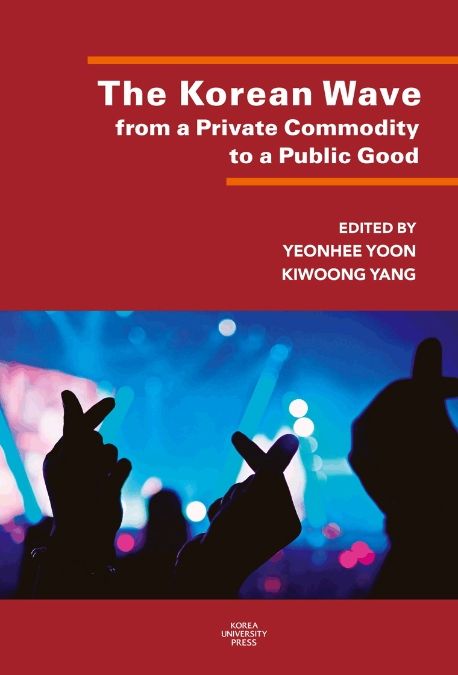
책소개The title of this book, The Korean Wave: from a Private Commodity to a Public Good, refers to the idea that the Korean Wave has now crossed its nation’s borders and become an international public good. Because the Korean Wave has so far surpassed its national borders to become a subject of global attention, we consider the Korean Wave through the lenses of power, interest, identity, politicization, and the “anti-Korean wave”.
“In this context, we are proud to have supported the work that has led to this publication. We congratulate the editors on promoting a unique interdisciplinary perspective on popular culture and international relations, featuring contributions by both humanists and social scientists, and focusing on a hugely signifcant transcultural phenomenon - the Korean Wave - that originated in Asia yet spread across the globe. The questions of identity, interest, and power raised by this publication, based on a series of conferences held on our campus, are as signifcant as they are innovative. I hope you, the reader, will be inspired by this collection to pursue your own inquiries and further develop the study of Korean culture in global context.”
- Michel Hockx, Director of Liu Institute for Asia and Asian Studies, University of Notre Dame
상세이미지 저자소개저자 : YeonHee Yoon
Yeonhee Yoon is a professor of the practice of the Korean Language and Culture at the Department of East Asian Languages and Cultures and faculty fellow at the Liu Institute of Asia and Asian Studies at the University of Notre Dame. She received her Ph.D. in Korean Linguistics from the University of Hawai’i at Manoa. Her research interests include Intercultural Pragmatics, Second Language Acquisition, and Korean popular culture. Her current project focuses on Korean History and Culture through Film, Korean Popular Culture and migration, Korean Language and Culture for International Negotiations and Diplomacy, and Korean language for academic purpose. Her recent publication include “Korean Hedges in Spoken Discourse” (2016) and “Korean Society” in Essentials of Korean Culture (2013).
저자 : Kiwoong Yang
Kiwoong Yang received his Ph.D. from the University of Tokyo in Japan. He is a 2015-16 academic year visiting fellow at Notre Dame’s Liu Institute for Asia and Asian Studies, is a tenured professor in the department of politics and public administration and a dean of the Graduate School of Global Cooperation at Hallym University, South Korea where he specializes in international relations among China, Japan, Korea, and the United States. He also serves a guest scholar for the academic year at Notre Dame’s Kellogg Institute for International Studies as well as taught a course titled Conflict and Cooperation in International Relations of East Asia for the fall 2015 semester and is currently teaching China, Japan, and Korea- The Impossible, Indispensible for the Spring 2016 semester. He is the author of numerous articles and books, including “South Korea and Japan’s frictions over history” Asian Perspective (2008) (written in English), Diplomacy and Negotiations in East Asia (2013) (written in Korean). While in residence at the Liu Institute, his research examines the escalation and negotiation of conflict in international relations of East Asia including such issues as the North Korea problem, historical conflicts and maritime territorial disputes among South Korea, China, and Japan.
목차Foreword
Michel Hockx (University of Notre Dame)
Preface
Yeonhee Yoon (University of Notre Dame) and Kiwoong Yang (Hallym University)
About the Contributors
Part 1: K-Pop as a Gateway to Korea
Chapter1
Exuberant Hallyu and Formidable Students: Two Faces of South Korean Youth Culture?
Susan D. Blum (University of Notre Dame)
Chapter 2
Korea’s Place in the World: Its Effort to Enhance Soft Power
Jaewoong Lee (Ministry of Foreign Affairs, Republic of Korea)
Part 2: Identity-dimension of the Korean Wave
Chapter 3
(Re)Imagined Communities: Korean Diaspora, Identity, and Pop Culture?
Ji-Yeon Jo (University of North Carolina-Chapel Hill)
Chapter 4
Drama Consumption in Transnational South Korea: Korean American Women and Intraethnic Othering?
Adrienne Lo (University of Waterloo), Megan Rim (University of Michigan), Lee Jin Choi (Hongik University), and Nancy Abelmann (University of Illinois at Urbana-Champaign)
Part 3: Interest-dimension of the Korean Wave
Chapter 5
A Hybrid Model of Bridging Nation Branding and Country Image: A Case of the Korean Wave?
Jaebeom Suh (Kansas State University)
Chapter 6
Yet to Crest: The Korean Wave and Korean Language Learning?
Yeonhee Yoon (University of Notre Dame)
Part 4: Power-dimension of the Korean Wave
Chapter 7
The Anti-Korean Wave in Japan: Identity Clash
Yeonhee Yoon (University of Notre Dame)
Chapter 8
The Korean Wave as a Soft Power?
Kiwoong Yang (Hallym University), Maddalena Ciesa (Max Mara)
Part 5: A Rivalry with the Korean Wave
Chapter 9
Between Fans: History and National Identity in Online Debates on Axis Powers Hetalia?
Kathryn Hemmann (George Mason University)
Chapter 10
Lost and Found in “Cool Japan”?
Heather Bowen-Struyk (DePaul University)
Appendix: Trends of the Korean Wave
The Korean Wave in the World Seen through Statistics?
Kiwoong Yang, Kyungeun Lee and Jeounghwa An (Hallym University)
Index |
| 교환 및 환불 가능 |
상품에 문제가 있을 경우 |
1) 상품이 표시/광고된 내용과 다르거나 불량(부패, 변질, 파손, 표기오류, 이물혼입, 중량미달)이 발생한 경우 - 신선식품, 냉장식품, 냉동식품 : 수령일 다음날까지 신청 - 기타 상품 : 수령일로부터 30일 이내, 그 사실을 안 날 또는 알 수 있었던 날로부터 30일 이내 신청 2) 교환 및 환불신청 시 판매자는 상품의 상태를 확인할 수 있는 사진을 요청할 수 있으며 상품의 문제 정도에 따라 재배송, 일부환불, 전체환불이 진행됩니다. 반품에 따른 비용은 판매자 부담이며 환불은 반품도착일로부터 영업일 기준 3일 이내에 완료됩니다. |
|
단순변심 및 주문착오의 경우 |
1) 신선식품, 냉장식품, 냉동식품 재판매가 어려운 상품의 특성상, 교환 및 환불이 어렵습니다. 2) 화장품 피부 트러블 발생 시 전문의 진단서 및 소견서를 제출하시면 환불 가능합니다. 이 경우 제반비용은 소비자 부담이며, 배송비는 판매자가 부담합니다. 해당 화장품과 피부 트러블과의 상당한 인과관계가 인정되는 경우 또는 질환치료 목적의 경우에는 진단서 발급비용을 판매자가 부담합니다. 3) 기타 상품 수령일로부터 7일 이내 신청, 왕복배송비는 소비자 부담 4) 모니터 해상도의 차이로 색상이나 이미지가 다른 경우 단순변심에 의한 교환 및 환불이 제한될 수 있습니다. |
|
| 교환 및 환불 불가 |
1) 신청기한이 지난 경우 2) 소비자의 과실로 인해 상품 및 구성품의 전체 또는 일부가 없어지거나 훼손, 오염되었을 경우 3) 개봉하여 이미 섭취하였거나 사용(착용 및 설치 포함)해 상품 및 구성품의 가치가 손상된 경우 4) 시간이 경과하여 상품의 가치가 현저히 감소한 경우 5) 상세정보 또는 사용설명서에 안내된 주의사항 및 보관방법을 지키지 않은 경우 6) 사전예약 또는 주문제작으로 통해 소비자의 주문에 따라 개별적으로 생산되는 상품이 이미 제작진행된 경우 7) 복제가 가능한 상품 등의 포장을 훼손한 경우 8) 맛, 향, 색 등 단순 기호차이에 의한 경우 |
|




 카테고리
카테고리
