

| 상품 안내 및 환불, 교환, 배송문의 | |
| - 가게 전화번호 : | 1544-1900 |
| - 전화문의 시간 : |
오전 9시부터 오후 6시까지 (매주 월요일, 화요일, 수요일, 목요일, 금요일, 공휴일 제외) |
| - 가게 이메일 : | ink@kyobobook.co.kr |
| - 이용 택배회사 : | CJ대한통운 |
|
판매가게정보 |
|
| - 사업자명 : | (주)교보문고 |
| - 사업자등록번호 : | 102-81-11670 |
| - 통신판매업신고 : | 01-0653 |
|
- 현금영수증 : 발급가능 |
|
|
전화주문 및 결제문의 |
|
| - 꽃피는 아침마을 : | 1644-8422 |
|
가게와 직거래를 하시면 꽃송이 적립 및 각종 혜택에서 제외되고, 만일의 문제가 발생하는 경우에도 꽃마의 도움을 받으실 수 없습니다. 가게의 부당한 요구, 불공정 행위 등에 대해서도 꽃마로 직접 전화주세요. |
|

| 상세정보 | 구매후기 (0) | 상품Q&A (0) | 배송/교환/환불 안내 |
책소개“창의력도 단련할 수 있다! 곧 정신의 무술이다.”
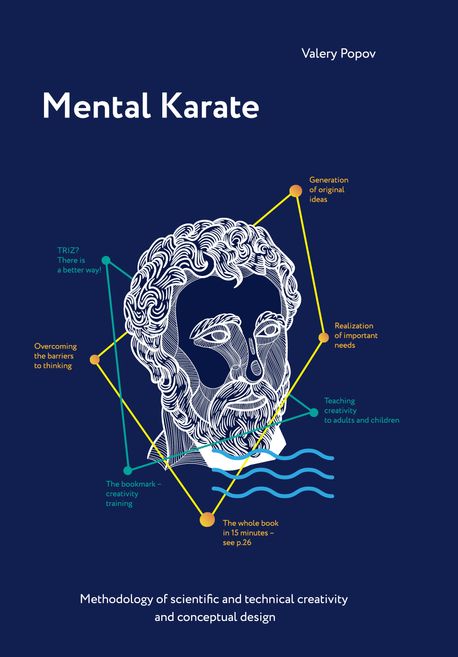
도서출판 뿌쉬낀하우스는 러시아의 발명가이자 창의 교육의 대가 발레리 V. 포포프(Valeriy V. Popov) 의 대표 저작 『멘탈 가라테: 과학기술 창의성과 개념설계 방법론』의 영문판(제4판)을 출간한다.
기술 변화가 가속화되는 오늘날, 포포프의 《멘탈 가라테》는 인간 중심적이면서도 실질적인 창의력 훈련 시스템을 제안한다. 그는 창의성을 무작위적인 ‘영감’이 아닌, 훈련 가능한 지적 기술로 정의하며, 이를 ‘정신의 가라테’라는 상징적 명칭으로 풀어낸다.
TRIZ(창의적 문제해결 이론)의 한계를 넘어서, 이 책은 심리학·시스템 사고·수사학·교육학을 아우르는 현대적 방법론으로, 복잡한 문제를 해결하고 새로운 아이디어를 설계하는 ‘창의적 전투법’을 소개한다.
이 책의 특징은 기존의 TRIZ 이론을 뛰어넘는 직관적이고 체계적인 설계방법론을 제시한다는 것인데, 저자는 이것을 8단계 휴리스틱 기법이라 칭한다. 8단계의 개념설계 프로세스를 통해 다양한 분야에서 창의적 사고로부터 만족할 만한 결과물을 도출해 내는 훈련을 한다.
발레리 포포프는 러시아연방 공훈발명가로서 채굴, 에너지, 구조공학, 의료기술 등 다양한 분야의 100건 이상의 특허를 보유하고 있으며, 수십 년간 발명 및 교육 경험을 바탕으로 창의력 교육을 이끌어왔다. 이번 영문판은 전문 번역가 알렉세이 넬류보프에 의해 완성되었다.
Mental Karate is a groundbreaking exploration into the nature of creativity, design thinking, and technological innovation. Building upon and critically expanding beyond the classic TRIZ methodology, this book presents an integrated system of ‘conceptual design’ rooted in human needs and powered by ‘heuristics’-the strategic techniques of mental discovery.
Valery Popov, a decorated Russian inventor, offers a comprehensive methodology that transforms creativity from a mysterious gift into a learnable and trainable skill. Drawing on decades of practical invention across multiple industries, the author distills creativity into eight distinct stages of conceptual design, each supported by heuristic tools that act like the techniques of martial arts-a “mental karate” for innovators.
상세이미지 목차Preface by the author _15
Chapter 1
Human needs - the main motive force of human actions
1.1 Basic concepts related to human needs _24
1.2 The reasons for the emergence and development of human needs _ 31
1.2.1 Environment is the main source of human needs _31
1.2.2 Insufficient protection of a man from threats _35
1.2.3 Insufficiently high level of population living standards _38
1.2.4 Manias and phobias _40
1.2.5 False needs _41
1.2.6 Noosphere and problems of sustainable development _43
1.3 Taxonomy of human needs _45
1.4 Phasing of human needs realization _47
1.4.1 The principle that determines the sequence of stages _47
1.4.2 Formation of technical system’s functions and properties _51
1.4.3 Formation of technical system’s functional structures _55
1.4.4 Formation of technical system’s operation principles _58
1.4.5 Technical decisions formation _63
1.4.6 Optimization of property parameters in technical decisions _66
1.4.7 Creation of a technical system and its life cycle _67
1.4.8 Characteristic phases of a technical system inception (creation),
development and withering away _68
Chapter 2
Realization of human needs - a creative process
2.1 Basic concepts of the creative process and scientific-technical creativity _71
2.2 The concept of "new" in scientific and technical creativity _74
2.3 Factors affecting the effectiveness of scientific and technical creativity _76
2.3.1 The efficiency level of knowledge convergence and the basal principle of
heuristics _76
2.3.2 Reproductive and productive knowledge _79
2.3.3 Creativity barriers _88
2.3.4 Qualities of a creative person _91
2.3.5 Motivation for creativity _93
Chapter 3
Scientific and technical (and other) creativity as the formation
and implementation of designs
3.1 Basic design concepts _97
3.2 Systematic methodology of design activities _98
3.2.1 Stages of design activities and their effectiveness _98
3.2.2 Strategy of technical systems design _102
3.2.2.1 Overview of design strategies _102
3.2.2.2 Strategy for increasing the results efficiency of technical systems’
design _103
3.2.2.3 Strategy for improving analogs of technical systems or creating new
generations of technical systems _104
3.2.2.4 Strategy for creating pioneering technical systems _105
3.2.3 Basic design tactics _105
3.2.3.1 Direct analogy tactics _105
3.2.3.2 Iterative approximations tactics _109
3.2.3.3 Creating pioneer technical systems tactics _112
3.3 Design result assessment and selection _112
Chapter 4
Contradictions in fulfillment of human needs
4.1 Basic concepts related to contradictions and types of contradictions _115
4.2 Typical and "physical" ("intensified") contradictions in technical systems _119
Chapter 5
General information on methods and means for resolving contradictions
in technical systems
5.1 Traditional methods and means based on the use of reproductive knowledge
_127
5.1.1 "Trial and error" method _127
5.1.2 Intuition and insight _127
5.1.3 Combinatorics _130
5.1.4 Inference by analogy (method of analogies) _133
5.1.5 Inference caused by associations _140
5.1.6 Imagination (fantasizing) _143
5.2 Heuristics, based on the use of productive knowledge for intensification of
innovative activity _151
5.2.1 General information about heuristics _151
5.2.2 The concept of the ideal final result _153
5.2.3 Models of creative activity _157
5.2.4 "Old" and "new" innovative cultures _161
Chapter 6
Methods and means used at the stages of setting, solving the problem
and commercialization of the result
6.1 General information about the stages of setting, solving the problem and
commercialization of the result _170
6.2 Problem setting _172
6.2.1 Once again about false needs _172
6.2.2 Natturalhuman needs and their use when setting a problem _173
6.2.2.1 Continuous and periodic the most important natural needs _173
6.2.2.2 Fulfillment of the most important human needs _178
6.2.3 Criteria for the progressive development of technical systems _179
6.2.3.1 Essence of progressive development criterion _179
6.2.3.2 Methodology for the formation of criteria for the progressive
development of technical systems _183
6.2.3.3 Examples of typical criteria for progressive development for various
classes of technical systems _184
6.2.3.4 Examples of directions formation for the implementation of criteria
for the progressive development of technical systems at various
stages of design _187
6.2.4 Formation of the ideal final result _187
6.2.5 Correctly formulated functions of a technical system when setting a
problem as the key of its successful solution _189
6.2.5.1 Rules for the formulation of functions _189
6.2.6 Laws and patterns of technical systems development and their use when
setting a problem _197
6.2.6.1 General information about the laws of technical systems
development _197
6.2.6.2 The law of technical systems stage development _199
6.2.6.3 The law of progressive evolution of technical systems _ 203
6.2.6.4 The law of correspondence between functions and the functional
structure of a technical system _205
6.2.7 Patterns in the development of technical systems _206
6.2.7.1 General information about patterns in the development of technical
systems _206
6.2.7.2 The pattern of TS development with a change in the properties of the
surfaces of TS elements _213
6.2.7.3 The pattern of TS development with switching to new types
of converted energy or field _214
6.2.7.4 The pattern of TS development with switching to new types
of mechanical movement _215
6.2.7.5 The pattern of TS development with a change in degrees number
of elements motion freedom in TS _215
6.2.7.6 The pattern of TS development with a change in the geometric
characteristics of objects mechanical contact _217
6.2.7.7 The pattern of TS development with a change in the configuration
of the elements of TS functional structure and the connections
between them in space _219
6.2.7.8 The pattern of TS development with a change in the relative position
of a pair of elements in TS _220
6.2.7.9 The pattern of TS development with a change in the geometric
characteristics that determine the shape of TS elements _220
6.2.7.10 The pattern of TS development with switching to new types of TS
elements symmetry _221
6.2.7.11 The pattern of TS development with a change in the characteristics
of the empty space in TS _222
6.2.7.12 The pattern of TS development with dividing TS elements into
parts _223
6.2.7.13 The pattern of TS development with switching to new connection
types of TS elements _224
6.2.7.14 The pattern of TS development with a change in the spatial
distribution of TS element’s substance properties and their
anisotropy _225
6.2.7.15 On the high heuristicity of generalized descriptions of TS
development patterns and the approach to the formation of such
descriptions _226
6.2.7.16 Generalized descriptions of TS development patterns and
forecasting new stages of TS development _230
6.2.7.17 The technique of using TS development patterns _ 240
6.2.7.18 Forecasting new patterns of TS development _241
6.2.7.19 Environmental laws _241
6.2.8 "Controlling", "good" and "bad" verbs for the formation of TS functions
_242
6.2.9 "Good" and "bad" adjectives to form TS properties _243
6.2.10 High creativity of using adjectives "smart" and "clean" when setting a task
_250
6.2.11 Creativity of using synonyms of verbs and adjectives when setting a task
_253
6.2.12 Metaphors and their use when setting a task _254
6.2.13 Focal Object Method _257
6.2.14 The "ascent-descent" method and its use when setting a task _261
6.2.15 Generalized methodological advice when setting a task _265
6.3 Problem solution _267
6.3.1 Functional cost analysis and synthesis of technical systems _267
6.3.2 Heuristic techniques _267
6.3.3 Intensified contradictions in technical systems and standards for their
resolution _275
6.3.4 Morphological analysis and synthesis of technical systems _281
6.3.5 Description of functional structures using elementary operations _283
6.3.6 The method of forming the principles of technical systems operation
based on physical, biological, chemical, geometric and economic effects
and phenomena _287
6.3.7 Traditional and non-traditional (hidden) resources and their use in
scientific and technical creativity _295
6.3.7.1 Traditional resources _295
6.3.7.2 Non-traditional (hidden) resources _296
6.3.7.3 Characteristics of non-traditional (hidden) resource classes _300
6.3.7.4 The technique for identifying and using non-traditional (hidden)
resources _301
6.3.8 Constructive mathematics, or the "STC +" operator _307
6.3.9 Use of laws and patterns of technical systems development _308
6.3.10 Use of materials with unusual properties _309
6.3.11 The use of illusions in technical and artistic creation _310
6.4 Formation of problem solving results _313
6.4.1 Formation of a variety of technical and other solutions _313
6.4.2 Protection of intellectual activity results and means of individualization
_313
6.4.3 Commercialization or other use of problem solving results _315
6.4.4 Determination of the direction for further improvement of a technical
system _315
6.5 Example of generating an idea and forming its effective technical decision using
heuristics _316
6.6 One hundred outstanding achievements of humanity _317
6.7 Promising directions for the development of technical systems _317
Chapter 7
Training of creative professionals
7.1 The growing demand for creative professionals and the limitation of vocational
education system _322
7.2 Formula for creative pedagogy _323
7.3 The functional structure of developed creative (projective) pedagogy _325
7.4 Didactics of creative (projective) pedagogy _329
7.5 On the criteria for the creativity of curricula, textbooks and manuals _330
7.6 Teaching children scientific and technical creativity _330
7.7 Prejudices and delusions of humanity, protection from frustration and "collapse
of the last hope" _331
Chapter 8
G.S. Altshuller is certainly great, but ... _335
Conclusion _345
책속으로“This book is about weaponizing creative thinking. Once you have a weapon, you engage in battle-and through battle, you transform both yourself and the world.”- p.8
“Creative thinking means constructing a structure of thought.”- p.10 “Originality is often nothing more than disguised clich?.”- p.11 “Conceptual design is a creative thought process that derives technological systems from human needs.”- p.13 “A heuristic is a kind of psychological weapon that triggers creative thinking. But without proper training, even a weapon becomes dangerous.”- p.17 “Creative thinking is a mental martial art-a fight against errors.”- p.21 “TRIZ fails to train the muscles of creativity. It is overly dogmatic and cannot truly mechanize creative thought.”- p.24 “Good design is not merely technical-it is philosophical and profoundly human.”- p.32 “Technological systems evolve toward doing more with fewer resources.”- p.49 “Mental Karate is the psychological martial art of training one’s creative weapon and sharpening one’s sense for conceptual design.”- p.62 출판사 서평Mental Karate: Methodology of Scientific and Technical Creativity and Conceptual Design is a groundbreaking contribution to the evolving field of creative problem-solving and innovation management. Rooted in decades of invention and design experience, this book by Valery V. Popov offers a compelling alternative-and thoughtful evolution-of the widely known TRIZ (Theory of Inventive Problem Solving).
Where TRIZ focuses heavily on formalized tools and contradiction-based resolution algorithms, Mental Karate proposes a more systemic, human-centered, and heuristic-driven methodology. The author recognizes the foundational value of TRIZ but critiques its conceptual vagueness, scientific inconsistencies, and limited educational accessibility. In response, he builds an integrated design framework that is not only technically rigorous but pedagogically intuitive.
At the heart of this book lies the 8-stage model of conceptual design-a methodical process that guides innovators from the identification of broad human needs to the development, refinement, and optimization of technical solutions. These stages include:
1. General human needs
2. Individual needs
3. Functional requirements
4. Consumer properties
5. Functional structure
6. Operating principles
7. Technical solution formation
8. Optimization of parameters
This model presents creativity not as an unpredictable spark, but as a trainable intellectual discipline-much like a martial art. Hence the name Mental Karate: a mental combat system of design thinking built upon strategic heuristics, not random intuition.
Popov’s approach is deeply interdisciplinary. It draws from systems engineering, philosophy, psychology, and even classical rhetoric. His use of heuristic techniques-such as the “ascent-descent” method, metaphor-driven ideation, and the classification of “good” and “bad” verbs and adjectives-translates into real-world tools that readers can apply not only in engineering and design, but in business, education, and personal decision-making.
This book is ideally suited for:
- Engineers, product designers, and inventors
- TRIZ practitioners seeking to broaden their methodology
- Educators and trainers in creativity and innovation
- Students of design thinking, systems science, and entrepreneurship
- Anyone interested in developing structured creative skills that are applicable in both professional and everyday life
Mental Karate challenges the myth of “innate genius” and instead empowers all readers-regardless of background-to engage with creativity as a practical, accessible, and even joyful activity. With clarity, depth, and vision, Popov delivers not only a new methodology but a new mindset for a complex, innovation-driven world. |
| 교환 및 환불 가능 |
상품에 문제가 있을 경우 |
1) 상품이 표시/광고된 내용과 다르거나 불량(부패, 변질, 파손, 표기오류, 이물혼입, 중량미달)이 발생한 경우 - 신선식품, 냉장식품, 냉동식품 : 수령일 다음날까지 신청 - 기타 상품 : 수령일로부터 30일 이내, 그 사실을 안 날 또는 알 수 있었던 날로부터 30일 이내 신청 2) 교환 및 환불신청 시 판매자는 상품의 상태를 확인할 수 있는 사진을 요청할 수 있으며 상품의 문제 정도에 따라 재배송, 일부환불, 전체환불이 진행됩니다. 반품에 따른 비용은 판매자 부담이며 환불은 반품도착일로부터 영업일 기준 3일 이내에 완료됩니다. |
|
단순변심 및 주문착오의 경우 |
1) 신선식품, 냉장식품, 냉동식품 재판매가 어려운 상품의 특성상, 교환 및 환불이 어렵습니다. 2) 화장품 피부 트러블 발생 시 전문의 진단서 및 소견서를 제출하시면 환불 가능합니다. 이 경우 제반비용은 소비자 부담이며, 배송비는 판매자가 부담합니다. 해당 화장품과 피부 트러블과의 상당한 인과관계가 인정되는 경우 또는 질환치료 목적의 경우에는 진단서 발급비용을 판매자가 부담합니다. 3) 기타 상품 수령일로부터 7일 이내 신청, 왕복배송비는 소비자 부담 4) 모니터 해상도의 차이로 색상이나 이미지가 다른 경우 단순변심에 의한 교환 및 환불이 제한될 수 있습니다. |
|
| 교환 및 환불 불가 |
1) 신청기한이 지난 경우 2) 소비자의 과실로 인해 상품 및 구성품의 전체 또는 일부가 없어지거나 훼손, 오염되었을 경우 3) 개봉하여 이미 섭취하였거나 사용(착용 및 설치 포함)해 상품 및 구성품의 가치가 손상된 경우 4) 시간이 경과하여 상품의 가치가 현저히 감소한 경우 5) 상세정보 또는 사용설명서에 안내된 주의사항 및 보관방법을 지키지 않은 경우 6) 사전예약 또는 주문제작으로 통해 소비자의 주문에 따라 개별적으로 생산되는 상품이 이미 제작진행된 경우 7) 복제가 가능한 상품 등의 포장을 훼손한 경우 8) 맛, 향, 색 등 단순 기호차이에 의한 경우 |
|



 카테고리
카테고리
