

| 상품 안내 및 환불, 교환, 배송문의 | |
| - 가게 전화번호 : | 1544-1900 |
| - 전화문의 시간 : |
오전 9시부터 오후 6시까지 (매주 월요일, 화요일, 수요일, 목요일, 금요일, 공휴일 제외) |
| - 가게 이메일 : | ink@kyobobook.co.kr |
| - 이용 택배회사 : | CJ대한통운 |
|
판매가게정보 |
|
| - 사업자명 : | (주)교보문고 |
| - 사업자등록번호 : | 102-81-11670 |
| - 통신판매업신고 : | 01-0653 |
|
- 현금영수증 : 발급가능 |
|
|
전화주문 및 결제문의 |
|
| - 꽃피는 아침마을 : | 1644-8422 |
|
가게와 직거래를 하시면 꽃송이 적립 및 각종 혜택에서 제외되고, 만일의 문제가 발생하는 경우에도 꽃마의 도움을 받으실 수 없습니다. 가게의 부당한 요구, 불공정 행위 등에 대해서도 꽃마로 직접 전화주세요. |
|

| 상세정보 | 구매후기 (0) | 상품Q&A (0) | 배송/교환/환불 안내 |
책소개영어교육 관련 통계분석은 이 한 권으로 끝낸다
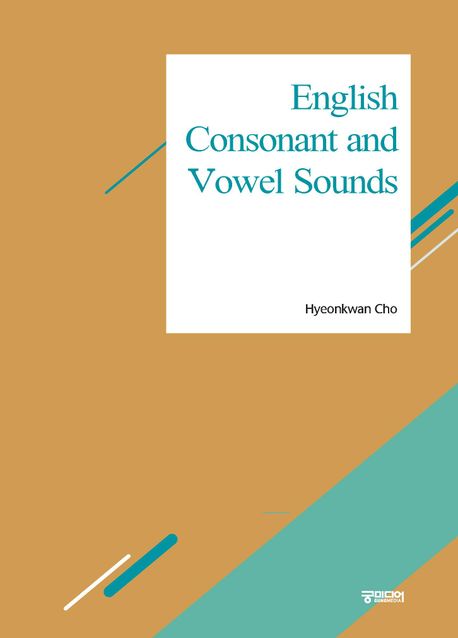
이 책은 조음음성학의 관점에서 영어 자음과 모음의 음성적 특성과 분류 원리를 제시하는 것으로 시작한다. 이어지는 단계에서는 음운론적 틀 안에서 영어 자음과 모음이 겪는 다양한 발음 변화를 다룬다. 마지막 단계에서는 음향음성학의 관점에서 영어 자음과 모음에 대한 음향적 특성을 설명한다. 조음음성학과 음운론에 관한 부분은 필자의 이전 저서 『영어 발음규칙과 발음표기』 (2014)의 일부를 영어로 번역한 것이며, 음향음성학 부분은 필자의 최근 저서인 『영어 자음·모음 강의노트』 (2023)를 영어로 번역한 것이다.
상세이미지 목차chapter 01 Introduction …11
chapter 02 English Phonemes and Spellings …29
chapter 03 Classification of English Phonemes …37
chapter 04 Allophonic Variations of English …73
chapter 05 Phonological Rules …133
chapter 06 Acoustic Phonetics …141
chapter 07 Practice and Evaluation Criteria …281
References …307
Appendix …309
책속으로Many people ask, “How many allophonic rules are there in English?” The answer is “infinite.” Even though each phoneme may have infinite allophones, it is practically and linguistically meaningless to explain all of them. Therefore, phonologists select and explain only the allophones that have prominent phonetic or acoustic characteristics. Additionally, some authors describe only the most representative allophonic rules, while others describe a wider range of rules. The allophonic rules that I want to introduce and explain to you in this book are the ones that are essential for Korean speakers to achieve native-like English pronunciation. If you study and apply these rules well, you can significantly improve your English pronunciation.
출판사 서평[ 저자서문 ]
This book begins by presenting the phonetic properties and classificatory principles of English consonants and vowels from the perspective of articulatory phonetics. The subsequent stage discusses, within a phonological framework, the various sound changes that English consonants and vowels undergo, formulated here as a set of systematic pronunciation rules. The final stage offers an acoustic analysis of English consonants and vowels from the standpoint of acoustic phonetics. The sections on articulatory phonetics and phonology are primarily adapted and translated from my earlier work, English Pronunciation Rules and Transcription (2014), while the section on acoustic phonetics draws on my more recent work, Lecture Notes on English Consonants and Vowels (2023).
As in all human languages, English sentences are composed of individual words, each of which is built from segmental units-consonants and vowels. These segments, however, vary considerably in their realized forms depending on the phonetic environment in which they occur. To help the reader’s understanding, let me provide a few examples. The consonant /l/ surfaces as the so-called ‘dark l,’ [?], in syllable-final or word-final position. The consonant /t/ becomes [?] when it appears between a vowel and an unstressed vowel. The sequence /?r/-a schwa followed by /r/-coalesces into a ‘rhotic schwa,’ [?]. The brief overview below is intended to help readers anticipate the overall structure and focus of this book.
From the perspective of articulatory phonetics, /l/ is classified as a voiced alveolar lateral liquid, /r/ as a voiced alveolar central liquid, and /t/ as a voiceless alveolar stop. The vowel /?/ is categorized as an unstressed mid central unrounded lax vowel. From a phonological standpoint, /l/ undergoes the velarization rule, which yields [?], and /t/ undergoes the flapping rule, producing [?]. The sequence /?r/ is subject to the schwa-merger rule, resulting in [?]. In terms of acoustic phonetics, [?] typically shows an F2 frequency around 1,000 Hz, [?] exhibits a closure duration of roughly 30ms or less, and [?] is characterized by an F3 frequency generally below 2,000 Hz.
This book is organized as follows. Chapter 1 offers an introduction to English articulatory phonetics and phonology. Chapter 2 provides a concise explanation of the relationship between English spelling and its phonetic transcription. Chapter 3 discusses the structure and function of the vocal organs, along with the linguistic principles used to classify English consonants and vowels. Chapter 4 presents a detailed account of nineteen allophonic rules, based on the relationship between phonemes and their allophones. Chapter 5 surveys a distinct class of phonological rules that operate beyond the domain of allophony. Chapter 6 introduces the fundamentals of acoustic phonetics and examines the acoustic properties of English consonants and vowels. Chapter 7 proposes acoustic evaluation criteria for pronunciation practice, with a particular focus on learners of English who are native speakers of Korean. |
| 교환 및 환불 가능 |
상품에 문제가 있을 경우 |
1) 상품이 표시/광고된 내용과 다르거나 불량(부패, 변질, 파손, 표기오류, 이물혼입, 중량미달)이 발생한 경우 - 신선식품, 냉장식품, 냉동식품 : 수령일 다음날까지 신청 - 기타 상품 : 수령일로부터 30일 이내, 그 사실을 안 날 또는 알 수 있었던 날로부터 30일 이내 신청 2) 교환 및 환불신청 시 판매자는 상품의 상태를 확인할 수 있는 사진을 요청할 수 있으며 상품의 문제 정도에 따라 재배송, 일부환불, 전체환불이 진행됩니다. 반품에 따른 비용은 판매자 부담이며 환불은 반품도착일로부터 영업일 기준 3일 이내에 완료됩니다. |
|
단순변심 및 주문착오의 경우 |
1) 신선식품, 냉장식품, 냉동식품 재판매가 어려운 상품의 특성상, 교환 및 환불이 어렵습니다. 2) 화장품 피부 트러블 발생 시 전문의 진단서 및 소견서를 제출하시면 환불 가능합니다. 이 경우 제반비용은 소비자 부담이며, 배송비는 판매자가 부담합니다. 해당 화장품과 피부 트러블과의 상당한 인과관계가 인정되는 경우 또는 질환치료 목적의 경우에는 진단서 발급비용을 판매자가 부담합니다. 3) 기타 상품 수령일로부터 7일 이내 신청, 왕복배송비는 소비자 부담 4) 모니터 해상도의 차이로 색상이나 이미지가 다른 경우 단순변심에 의한 교환 및 환불이 제한될 수 있습니다. |
|
| 교환 및 환불 불가 |
1) 신청기한이 지난 경우 2) 소비자의 과실로 인해 상품 및 구성품의 전체 또는 일부가 없어지거나 훼손, 오염되었을 경우 3) 개봉하여 이미 섭취하였거나 사용(착용 및 설치 포함)해 상품 및 구성품의 가치가 손상된 경우 4) 시간이 경과하여 상품의 가치가 현저히 감소한 경우 5) 상세정보 또는 사용설명서에 안내된 주의사항 및 보관방법을 지키지 않은 경우 6) 사전예약 또는 주문제작으로 통해 소비자의 주문에 따라 개별적으로 생산되는 상품이 이미 제작진행된 경우 7) 복제가 가능한 상품 등의 포장을 훼손한 경우 8) 맛, 향, 색 등 단순 기호차이에 의한 경우 |
|




 카테고리
카테고리
