

| 상품 안내 및 환불, 교환, 배송문의 | |
| - 가게 전화번호 : | 1544-1900 |
| - 전화문의 시간 : |
오전 9시부터 오후 6시까지 (매주 월요일, 화요일, 수요일, 목요일, 금요일, 공휴일 제외) |
| - 가게 이메일 : | ink@kyobobook.co.kr |
| - 이용 택배회사 : | CJ대한통운 |
|
판매가게정보 |
|
| - 사업자명 : | (주)교보문고 |
| - 사업자등록번호 : | 102-81-11670 |
| - 통신판매업신고 : | 01-0653 |
|
- 현금영수증 : 발급가능 |
|
|
전화주문 및 결제문의 |
|
| - 꽃피는 아침마을 : | 1644-8422 |
|
가게와 직거래를 하시면 꽃송이 적립 및 각종 혜택에서 제외되고, 만일의 문제가 발생하는 경우에도 꽃마의 도움을 받으실 수 없습니다. 가게의 부당한 요구, 불공정 행위 등에 대해서도 꽃마로 직접 전화주세요. |
|

| 상세정보 | 구매후기 (0) | 상품Q&A (0) | 배송/교환/환불 안내 |
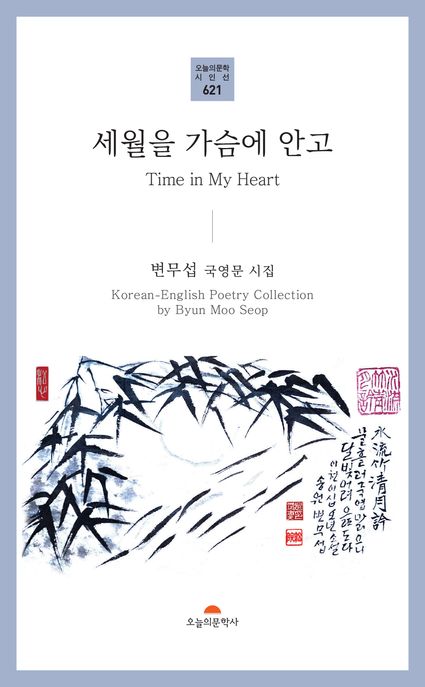
책소개시인이자 서예가인 변무섭 문학박사가 1시집 『세월을 가슴에 안고(Time in My Heart)』를 오늘의문학사에서 발간하였습니다. 이 시집은 ‘한국어-영어’ 대역본(Korean-English Poetry Collection)이며, 영문학을 전공한 변무섭 박사의 자작 시집입니다. 이 시집은 ‘저자의 말’ ‘제1부 받으소서’ ‘제2부 그리움’ ‘고향살이’ ‘제4부 내 사랑 자연’ ‘시집 해설 - 리헌석 문학평론가’ 등으로 구성되어 있습니다.
상세이미지 저자소개저자 : 변무섭
Byun Moo Seop
시인, 문학사랑협의회 이사 Poet, Director of Literature Love
국제펜문학 한국본부 회원 Member of PEN, KOREA
한국계관시인협회 회원 Member of United Poets Laureate
International, Korea Center
서예 초대작가 Invited Seoye Writer
정년퇴직 교수 Retired Professor
황조근정훈장 Hwangjo Geunjeong Medal Awarded
대전 출생 Born in Daejeon 1946
대전고 Daejeon High School
공주사범대학 영어교육과
Dept of English Education, Gongju Teacher’s College
ROTC 보병통역장교 Infantry Interpreter Officer
DipTESL Victoria University of Wellington, New Zealand
충남대학교 대학원 영어학 문학 석박사
MA & Dr. of English Language Literature, Chungnam Univ
대전고 영어 교사 Teacher of English, Daejeon High School
대전보건대학교 영어 교수
Prof. of English Language Literature, Daejeon Health University
목차저자의 말|Author's Note 5
제1부 받으소서
Part Ⅰ Please Accept
이리로 오라|Come Here 14
받아들이게 하소서
|Please Let Me Accept My Neighbours 16
하늘바라기|Sky Gazing 20
없다|Nonexistence 24
침묵|Silence 26
밤과 낮|Day and Night 28
밀지 마라|Don't Push 30
세월|Time 32
오늘을 맡겨라|Leave It to Me Today 34
바람|Wind 36
제2부 그리움
Part Ⅱ Longing
그리움|Longing 42
흰 눈|White Snow 44
어서 일어나라|Come on, Get up 46
아버지|Father 50
외로움|Loneliness 52
아이고, 이놈아|Oh My Boy 56
어머니의 치마|My Mother's Chima 60
어머니의 손|Mother's Hand 62
목화|Cotton 64
승언과 미도의 재회
|Seungeon and Mido's Reunion 68
꽃봉오리|Flower Buds 72
그림자|Shadow 74
그리워라 어린 시절
|Missing My Childhood 76
제3부 고향 살이
Part Ⅲ Life in My Hometown
강|The River 80
마당|Front Yard 82
아름다운 산|A Beautiful Mountain 84
찬샘정에서|Chansaemjeong Outlook 86
고향 하늘|Home Sky 90
진달래 순아|Azalea Suna 94
토광|Togwang, Earthen Wareroom 96
노고산성|Nogo Castle 100
산길|The Mountain Path 102
제4부 내 사랑 자연
Part Ⅳ My Love, Nature
겨울 바다|Winter Sea 106
겨울나무|Winter Trees 108
가을바람|Autumn Wind 112
가을 빗방울|Autumn Raindrops 114
가을 하늘|Autumn Sky 116
낙엽|Fallen Leaves 118
낙화|Falling Flowers 120
홍수|Flood 122
안개|Fog 124
봄을 기다리며|Waiting for Spring 126
내 사랑 꽃망울|My Love Flower Buds 128
이별|Separation 130
솟아라, 태양아|Rise up, the Sun 132
시집 해설 _ 리헌석 문학평론가|Commentary on the Poetry Collection _ Lee Heon-seok, literary critic and chairman of Literature Love Association. Translated by the author, Byun Moo Seop 134
출판사 서평(리헌석 문학평론가의 해설 중에서 따온 글)
#1 - 시인은 첩첩산중, 그 마을에서 태어나고 자랍니다. 산골 소년이 자라서, 대학교의 명망 높은 영문학자가 되고, 서예에 입문하여 추사체(秋史體)를 비롯하여 여러 서체를 연마한 초대작가이며, 고희를 넘겨 시인으로 등단하였으니, 그의 일생은 가히 입지전적(立志傳的) 삶이라 하겠습니다. 그러함에도 불구하고 그는 시종여일(始終如一) 겸손한 자세를 견지하고 있으니, 그의 인품은 실로 아름다운 바가 있습니다. 그가 창작한 시에서도 아름다운 추억이 오롯하게 공감각적 이미지로 형상화되어 있습니다.
(The poet was born and raised in this village, nestled in the mountains. A boy from the mountains grew up to become a renowned English literature scholar at a prestigious university, became a renowned calligrapher who mastered calligraphy, including the Chusa style, and debuted as a poet after turning 70. His life can be considered a journey of determination. Despite this, he maintains a humble attitude throughout, a trait that is truly endearing. His poetry, too, embodies beautiful memories, transcending the boundaries of synesthetic imagery.)
#2 - 변무섭 시인의 작품에서 중심을 이루는 경향은 고향에 대한 그리움, 어머니와 아버지에 대한 사랑, 그리고 이에서 파생된 정서 등으로 보입니다. 특히 어머니에 대한 제재가 눈물겨운 정도로 두드러집니다. 시인에게 쏟아부은 어머니의 희생적 사랑에 대한 추억 때문인 것 같습니다.
(The central themes in poet Byun Moo Seop's work seem to be longing for home, love for mother and father, and the emotions derived from these. The theme of his mother is particularly poignant, perhaps reflecting memories of her sacrificial love for him.)
#3 - 변무섭 시인의 작품에 설의법(設疑法)이 자주 원용됩니다. 설의법은 쉽게 판단할 수 있는 사실과 논리를 의문문 형식으로 제시하여 독자가 스스로 답을 찾거나 논리를 유추하게 하는 수사법(修辭法)이어서, 시인은 물론 여러 분야의 사람이 다용(多用)합니다. 따라서 변무섭 시인만의 표현적 특징일 수는 없을 터이나, 그 빈도가 높고, 특정 작품은 각 연을 설의법만으로 구성하고 있어 개성적 특징으로 볼 수도 있습니다.
(Poet Byun Moo Seop frequently employs the method of "suggesting doubt" (設疑法). This rhetorical device presents easily discernible facts and logic in the form of a question, prompting the reader to find the answer or infer the logic. It is widely used by poets and others in various fields. While it may not be a uniquely expressive characteristic of the poet, its frequency, and the fact that certain works exclusively use the method in each stanza, make it a distinctive feature.)
#4 - 변무섭 시인의 조상 대은 변안열(大隱 邊安烈)은 고려 말의 충신으로 문무를 겸하셨습니다. 공의 직은 영삼사사(領三司事)에 이른 문인이었을 뿐만 아니라, 이성계 장군과 더불어 남원 황산대첩에서 왜적을 섬멸하였으며, 북방을 수없이 침범한 오랑캐를 물리친 명장입니다. 또한 그는 목은(牧隱), 야은(冶隱), 포은(圃隱) 삼은(三隱)과 함께 추앙받는 ‘대은(大隱)’이십니다. 그분의 후손이 정착하여, 대를 이어 내려온 고향 산천은 시인에게 역설적 호감을 유지하게 합니다.
(Poet Byun Moo Seop is a member of the Wonju Byun clan, and his progenitor was Byun An-ryeol (邊安烈), a loyal subject of the late Goryeo Dynasty who held both civil and military posts. He rose to the position of Yeongsamsasa (領三司事). Along with General Yi Seong-gye, he not only decisively defeated the Japanese pirates in the Battle of Hwangsan, Namwon, but also defeated countless northern barbarians. He is also revered as a "Dae-eun" (大隱), along with the three hermits Mok-eun(牧隱), Ya-eun(冶隱), and Po-eun(圃隱). The mountains and rivers of his hometown, where his descendants settled and passed down through generations, paradoxically evoke a fondness for the poet.) |
| 교환 및 환불 가능 |
상품에 문제가 있을 경우 |
1) 상품이 표시/광고된 내용과 다르거나 불량(부패, 변질, 파손, 표기오류, 이물혼입, 중량미달)이 발생한 경우 - 신선식품, 냉장식품, 냉동식품 : 수령일 다음날까지 신청 - 기타 상품 : 수령일로부터 30일 이내, 그 사실을 안 날 또는 알 수 있었던 날로부터 30일 이내 신청 2) 교환 및 환불신청 시 판매자는 상품의 상태를 확인할 수 있는 사진을 요청할 수 있으며 상품의 문제 정도에 따라 재배송, 일부환불, 전체환불이 진행됩니다. 반품에 따른 비용은 판매자 부담이며 환불은 반품도착일로부터 영업일 기준 3일 이내에 완료됩니다. |
|
단순변심 및 주문착오의 경우 |
1) 신선식품, 냉장식품, 냉동식품 재판매가 어려운 상품의 특성상, 교환 및 환불이 어렵습니다. 2) 화장품 피부 트러블 발생 시 전문의 진단서 및 소견서를 제출하시면 환불 가능합니다. 이 경우 제반비용은 소비자 부담이며, 배송비는 판매자가 부담합니다. 해당 화장품과 피부 트러블과의 상당한 인과관계가 인정되는 경우 또는 질환치료 목적의 경우에는 진단서 발급비용을 판매자가 부담합니다. 3) 기타 상품 수령일로부터 7일 이내 신청, 왕복배송비는 소비자 부담 4) 모니터 해상도의 차이로 색상이나 이미지가 다른 경우 단순변심에 의한 교환 및 환불이 제한될 수 있습니다. |
|
| 교환 및 환불 불가 |
1) 신청기한이 지난 경우 2) 소비자의 과실로 인해 상품 및 구성품의 전체 또는 일부가 없어지거나 훼손, 오염되었을 경우 3) 개봉하여 이미 섭취하였거나 사용(착용 및 설치 포함)해 상품 및 구성품의 가치가 손상된 경우 4) 시간이 경과하여 상품의 가치가 현저히 감소한 경우 5) 상세정보 또는 사용설명서에 안내된 주의사항 및 보관방법을 지키지 않은 경우 6) 사전예약 또는 주문제작으로 통해 소비자의 주문에 따라 개별적으로 생산되는 상품이 이미 제작진행된 경우 7) 복제가 가능한 상품 등의 포장을 훼손한 경우 8) 맛, 향, 색 등 단순 기호차이에 의한 경우 |
|



 카테고리
카테고리
