

| 상품 안내 및 환불, 교환, 배송문의 | |
| - 가게 전화번호 : | 1544-1900 |
| - 전화문의 시간 : |
오전 9시부터 오후 6시까지 (매주 월요일, 화요일, 수요일, 목요일, 금요일, 공휴일 제외) |
| - 가게 이메일 : | ink@kyobobook.co.kr |
| - 이용 택배회사 : | CJ대한통운 |
|
판매가게정보 |
|
| - 사업자명 : | (주)교보문고 |
| - 사업자등록번호 : | 102-81-11670 |
| - 통신판매업신고 : | 01-0653 |
|
- 현금영수증 : 발급가능 |
|
|
전화주문 및 결제문의 |
|
| - 꽃피는 아침마을 : | 1644-8422 |
|
가게와 직거래를 하시면 꽃송이 적립 및 각종 혜택에서 제외되고, 만일의 문제가 발생하는 경우에도 꽃마의 도움을 받으실 수 없습니다. 가게의 부당한 요구, 불공정 행위 등에 대해서도 꽃마로 직접 전화주세요. |
|

| 상세정보 | 구매후기 (0) | 상품Q&A (0) | 배송/교환/환불 안내 |
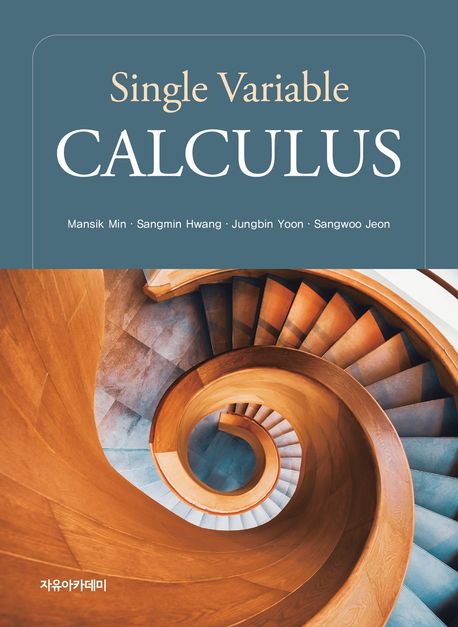
책소개2026년 01월 25일 출간 | ISBN : 1158088035 | 402쪽 | 규격外
상세이미지 목차01 Functions
1.1 Functions
1.2 Exponents1.3 Logarithmic Functions
1.4 Trigonometric Equations
Multiple Choice
02 Limits and Continuity
2.1 Limit Existence
2.2 Squeezing Theorem (Sandwich Theorem)
2.3 Limit of Trigonometric Function
2.4 Limit of Exponential and Logarithmic Functions
2.5 Limits Involving Infinity
2.6 Continuity
2.7 Average Rate of Change and Instantaneous Rate of Change
2.8 Intermediate Value Theorem (I.V.T.)
Multiple Choice
03 Derivatives
3.1 Definition of Derivative
3.2 Differentiability
3.3 Power Rule
3.4 Product Rule
3.5 Quotient Rule
3.6 Chain Rule
3.7 Implicit Differentiation
3.8 Higher Order Derivatives
3.9 Derivatives of Trigonometric Functions
3.10 Derivatives of Exponential Functions
3.11 Derivatives of Logarithmic Functions
3.12 Inverse Trigonometric Functions
3.13 Derivatives of Inverse Trigonometric Functions
3.14 Derivatives of Inverse Functions
Multiple Choice
04 Application of Derivatives
4.1 Critical Points
4.2 Extrema: Maximum & Minimum value
4.3 Concavity
4.4 Curve Sketching
4.5 Relation of f′(x), f′′(x) to the Graph of f(x)
4.6 Motion Along a Line (1-Dimension)
4.7 Motion Along a Curve: Velocity and Acceleration Vectors
4.8 Modeling and Optimization
4.9 Related Rates
4.10 Mean Value Theorem (M.V.T)
4.11 Local Linear Approximation
4.12 Newton's Method
4.13 Approximating Derivatives Numerically
4.14 Indeterminate Forms and L'Hospital's Rule
Multiple Choice
05 Integration
5.1 Indefinite Integrals
5.2 Integration by Substitution
5.3 Integration by Parts
5.4 Rectangular Approximation Method (RAM)
5.5 Trapezoidal Approximation
5.6 Definition of Area as a Limit
5.7 Definite Integrals
5.8 Fundamental Theorem of Calculus, Part I
5.9 Fundamental Theorem of Calculus, Part II
5.10 Area between a curve and the x-axis
5.11 Substitution for Definite Integrals
5.12 Integration by Parts for Definite Integrals
5.13 Even and Odd Functions
5.14 Integration by Partial Fraction
Multiple Choice
06 Applications of Definite Integrals
6.1 Average Value of a Function
6.2 Area Between Curves
6.3 Volume of Solids with Known Cross Sections
6.4 Volume of Solids of Revolution:
Disk, Washers and Cylindrical Shells
6.5 Definite Integral of a Rate is Net Change
6.6 Motion Along a Straight Line (1-Dimension)
6.7 Motion Along a Plane Curve
6.8 Arc Length
6.9 Improper Integrals
Multiple Choice
07 Differential Equations
7.1 Slope Fields (Direction Fields)
7.2 First Order Separable Differential Equations
7.3 Exponential Growth and Decay
7.4 Euler's Method
7.5 Logistic Growth
Multiple Choice
Solution
Index
책속으로[머리말] We wrote this calculus textbook for students seriously considering a career in STEM: Science, Technology, Engineering, and Mathematics. Having taught calculus for over thirty years at universities, we have gained invaluable insights into making the material more accessible and less daunting through the use of simple, direct language. Thus, even for students with weak mathematical foundations or for those who are approaching calculus for the very first time, we believe that this textbook can facilitate their comprehension. Numerous examples and problem sets were designed so that the major concepts of calculus could be understood, then solved, and finally applied. The contents of this book are as follows. Chapter 1 introduces the definitions of functions and deals with inverse and composite functions. Specifically, exponential functions, logarithmic functions, and trigonometric functions-all crucial parts in science and engineering-are thoroughly examined. Chapter 2 deals with the limits of functions and the concept of continuity. Special attention is paid to the limits of transcendental functions and the limits at infinity, as well as the mean value theorem through continuity. Chapter 3 introduces derivatives and deals with tangent and normal line equations, as well as various differential calculations using slope. Chapter 4 examines the close relationship between mathematics and its practical applications in real life via local maxima, local minima, and optimization problems. Chapter 5 introduces indefinite integrals and definite integrals, focusing on the relationship between the derivative and the integral through the fundamental theorem of calculus. Chapter 6 introduces the application of definite integrals. Mainly examined are the areas between curves, the volume of revolution, the motion of curves, the length of arcs on a plane, and improper integrals. This chapter expands the concepts of derivatives or integrals from single-variable calculus to solve problems related to maximum or minimum values of multivariate functions or volumes of solids, helping students understand physical phenomena using vector functions. Chapter 7 deals with differential equations. We received a lot of help from Jungbin Yoon in writing this book. In reviewing the text, examples, and exercises, they offered creative solutions and multiple-choice questions, providing student perspectives that allowed us to anticipate potential difficulties in the material. Among the many examples that come to mind, while calculating the limit of a trigonometric function, instead of obtaining the derivative first, Jungbin Yoon suggested an easier method of obtaining the graph by transforming the given trigonometric function. It was through their diligence that, in the process of substitution integration, they organized the solution themselves to solve a first-order linear differential equation, thereby greatly improving the quality of this book. In addition, Jungbin Yoon’s careful review of the text and scope of this book, correcting formulas as well as English grammar, allowed us to devote our energies to the mathematical concepts and the overarching whole of the project. Finally, we would like to extend our special gratitude to our publisher, Freedom Academy. Any corrections or updates identified after publication will be made available in the Resources section of the Freedom Academy website (www.freeaca.com) for reference. We hope that this textbook can help students develop a better understanding and appreciation of calculus and the benefits it will have in their professional lives. |
| 교환 및 환불 가능 |
상품에 문제가 있을 경우 |
1) 상품이 표시/광고된 내용과 다르거나 불량(부패, 변질, 파손, 표기오류, 이물혼입, 중량미달)이 발생한 경우 - 신선식품, 냉장식품, 냉동식품 : 수령일 다음날까지 신청 - 기타 상품 : 수령일로부터 30일 이내, 그 사실을 안 날 또는 알 수 있었던 날로부터 30일 이내 신청 2) 교환 및 환불신청 시 판매자는 상품의 상태를 확인할 수 있는 사진을 요청할 수 있으며 상품의 문제 정도에 따라 재배송, 일부환불, 전체환불이 진행됩니다. 반품에 따른 비용은 판매자 부담이며 환불은 반품도착일로부터 영업일 기준 3일 이내에 완료됩니다. |
|
단순변심 및 주문착오의 경우 |
1) 신선식품, 냉장식품, 냉동식품 재판매가 어려운 상품의 특성상, 교환 및 환불이 어렵습니다. 2) 화장품 피부 트러블 발생 시 전문의 진단서 및 소견서를 제출하시면 환불 가능합니다. 이 경우 제반비용은 소비자 부담이며, 배송비는 판매자가 부담합니다. 해당 화장품과 피부 트러블과의 상당한 인과관계가 인정되는 경우 또는 질환치료 목적의 경우에는 진단서 발급비용을 판매자가 부담합니다. 3) 기타 상품 수령일로부터 7일 이내 신청, 왕복배송비는 소비자 부담 4) 모니터 해상도의 차이로 색상이나 이미지가 다른 경우 단순변심에 의한 교환 및 환불이 제한될 수 있습니다. |
|
| 교환 및 환불 불가 |
1) 신청기한이 지난 경우 2) 소비자의 과실로 인해 상품 및 구성품의 전체 또는 일부가 없어지거나 훼손, 오염되었을 경우 3) 개봉하여 이미 섭취하였거나 사용(착용 및 설치 포함)해 상품 및 구성품의 가치가 손상된 경우 4) 시간이 경과하여 상품의 가치가 현저히 감소한 경우 5) 상세정보 또는 사용설명서에 안내된 주의사항 및 보관방법을 지키지 않은 경우 6) 사전예약 또는 주문제작으로 통해 소비자의 주문에 따라 개별적으로 생산되는 상품이 이미 제작진행된 경우 7) 복제가 가능한 상품 등의 포장을 훼손한 경우 8) 맛, 향, 색 등 단순 기호차이에 의한 경우 |
|



 카테고리
카테고리
