

| 상품 안내 및 환불, 교환, 배송문의 | |
| - 가게 전화번호 : | 1544-1900 |
| - 전화문의 시간 : |
오전 9시부터 오후 6시까지 (매주 월요일, 화요일, 수요일, 목요일, 금요일, 공휴일 제외) |
| - 가게 이메일 : | ink@kyobobook.co.kr |
| - 이용 택배회사 : | CJ대한통운 |
|
판매가게정보 |
|
| - 사업자명 : | (주)교보문고 |
| - 사업자등록번호 : | 102-81-11670 |
| - 통신판매업신고 : | 01-0653 |
|
- 현금영수증 : 발급가능 |
|
|
전화주문 및 결제문의 |
|
| - 꽃피는 아침마을 : | 1644-8422 |
|
가게와 직거래를 하시면 꽃송이 적립 및 각종 혜택에서 제외되고, 만일의 문제가 발생하는 경우에도 꽃마의 도움을 받으실 수 없습니다. 가게의 부당한 요구, 불공정 행위 등에 대해서도 꽃마로 직접 전화주세요. |
|

| 상세정보 | 구매후기 (0) | 상품Q&A (0) | 배송/교환/환불 안내 |
책소개2025년 12월 12일 출간 | ISBN : 1130398609 | 452쪽 | 규격外
상세이미지 목차EDITORIAL NOTE
Junha KangㆍAngela Semee Kim _ 11
ARTICLES
See-Hwan DOH
A Review of Sakutaro Tachi’s Distortion of the Principles of International Law on Japan’s Invasion of Dokdo in 1905 _ 17
Lucas Carlos LIMA
The International Tribunal for the Law of the Sea’s Advisory Opinion on Climate Change: A Rift Among Equals? _ 39
Aziz Tuffi SALIBAㆍLutiana Valadares Fernandes BARBOSA
Artificial Intelligence and Human Rights: A Double-Edged Sword _ 81
Changwan HAN
Three Blades of Leverage: A Critical Perspective on the Korea-China Investment Treaty Framework _ 115
Yunjeong HWANG
International Divorce in Korea: Legal Framework and Practical Issues _ 163
SPECIAL REPORTS
Jinwoong SEO
Ecologically or Biologically Significant Marine Areas (EBSAs) in the Convention on Biological Diversity and the Issue of Dokdo _ 199
Jang-Hie LEE
Victims of Japanese Forced Labor & Its Approach By the Transitional Justice of the UN Human Rights Committee in the ICCPR _ 217
Ju Eun LEE
Application of Korean Data Privacy Regulations to Foreign Business Operators _ 229
RECENT DEVELOPMENTS
Gyooho LEE
The Framework Act on National Heritage and Related Laws _ 265
Minjung CHUNG
The Possibility of the 2028 Termination of the Korea-Japan Joint Development Agreement on the Continental Shelf and Anticipated Consequences _ 277
CONTEMPORARY PRACTICE AND JUDICIAL DECISIONS
Minjung CHUNG
Resolutions Relating to International Law Adopted by the National Assembly in 2024 _ 295
Eungi HONG
Judicial Decisions in Public International Law (2024) _ 303
Jung Hwa YOU
Judicial Decisions in Private International Law (2024) _ 327
KOREAN DOMESTIC LAWS _ 341
TREATIES/AGREEMENTS CONCLUDED BY THE REPUBLIC OF KOREA _ 345
INDEX _ 347
AUTHOR GUIDELINES AND STYLE SHEET _ 353
출판사 서평EDITORIAL NOTE
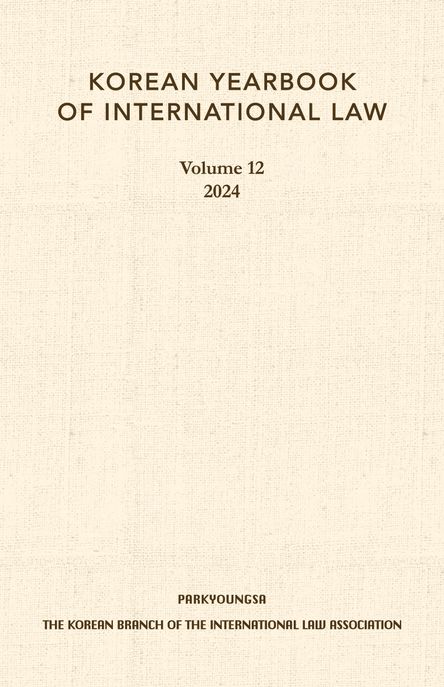
It is our great pleasure to present Volume 12 of the Korean Yearbook of International Law. We would like to express our sincere gratitude to the thirteen authors for their insightful contributions regarding the current development of international law in the Republic of Korea. This volume consists of an array of topics including but not limited to the law on cultural and national heritage, judicial decisions regarding both public and private international law, data privacy, law of the sea, artificial intelligence (AI), environmental law, Korea-Japan relations, and Korea-China Investment Treaty.
Professor Gyooho Lee’s article on “The Framework Act on National Heritage and Related Laws” covers the most recent law on national heritage enacted in the Republic of Korea on May 16, 2024. The article provides a thorough discussion on the purpose of the Act, keynote provisions, and how the Act aligns with the international standard of the UNSECO system. The author emphasizes the importance of the Act, which purports to transform the cultural heritage system into a national heritage system by changing and expanding the name of cultural property by subdividing it into cultural heritage, natural heritage, and intangible heritage.
Honorable Judge Jung Hwa You provided his insight into the recent judicial decisions in private international law decided in 2024, specifically focusing on three major 2024 Supreme Court decisions in Korea related to private international law, dealing with contract law (Supreme Court decision (2019Da261558)), arbitration matters Supreme Court decision (2024Ma5904)), and insurance law (Supreme Court decision (2019Da256501)), respectively. Honorable Judge Eun Gi Hon covered three landmark decisions held in 2024, focusing on public international law, including the status of same-sex partners under the National Health Insurance system, the reduction of greenhouse gas reduction targets under environmental law, and administrative regulations regarding access to facilities for persons with disabilities.
Considering the progressively development of data protection law and extraterritoriality, Attorney Ju Eun Lee’s article on “Application of Korean Data Privacy Regulations to Foreign Business Operators” examines the extraterritorial application of Korea’s Personal Information Protection Act (PIPA) to foreign business operators by providing an in-depth analysis of the 2024 Guidelines issues by the Personal Information Protection Commission (PIPC).
Contributing to the Yearbook are renown international scholars, Professor Lucas Carlos Lima, Professor Aziz Tuffi Saliba and Professor Lutiana Valadares Fernandes Barbosa. Professor Lucas Carlos Lima’s article on “The International Tribunal for the Law of the Sea’s Advisory Opinion on Climate Change: A Rift Among Equals” discusses the most recent landmark ICJ Advisory Opinion on climate change and its implications to the international community.
With the rapid development in AI, Professor Aziz Tuffi Saliba and Professor Lutiana Valadares Fernandes Barbosa’s article on “Artificial Intelligence and Human Rights: A Double-Edged Sword” focuses on both the implications of artificial intelligence to the obligations to protect, respect, and fulfill economic, social and cultural rights, and also the challenges of human rights issues in the context of the AI revolution.
Continuously contributing to the historical aspects of international law in the Republic of Korea, Director General See-Hwan Doh’s article on “A Review of Sakutaro Tachi’s Distortion of the Principles of International Law on Japan’s Invasion of Dokdo in 1905” commemorates the 80th anniversary of Korea’s liberation from Japanese colonial rule and the 60th anniversary of the normalization of diplomatic relations between Korea and Japan, by historically analyzing the essential problems of the distortion of the principles of international law in Japanese claims to Dokdo raised by mobilizing international law. Professor Jang-Hie Lee contributed to this volume through his analysis of the Korea-Japan’s relations focusing on the victims of Japanese forced labor and the recent Korean Supreme Court decision that ruled in favor of the victims of forced labor for the first time, in his article “Victims of Japanese Forced Labor & Its Approach by the Transitional Justice of the UN Human Rights Committee in the B (ICCPR) Covenant of the Human Rights”.
Considering the ongoing importance on environmental law and maritime delimitations in international law, Mr. Jinwoong Seo’s article on “Ecologically or Biologically Significant Marine Areas (EBSAs) in the Convention on Biological Diversity and the Issue of Dokdo” interprets the Convention on Biological Diversity and its new proposal of the Ecologically or Biologically Significant Marine Areas (EBSAs) by critically examining the current trends in EBSAs and potential issues that may arise.
Dr. Min-Jung Chung provides two contributions on the current developments in legislation in the Republic of Korea, one focusing on the “Resolution Relating to International Law Adopted by the National Assembly in 2024” and the other focusing on “The Possibility of the 2028 Termination of the Korea-Japan Joint Development Agreement on the Continental Shelf and Anticipated Consequences”. As the National Assembly of the Republic of Korea expresses its positions in the form of resolutions, Dr. Chung’s article on the “Resolutions Relating to International Law Adopted by the National Assembly in 2024” is crucial in this year’s volume as there are two resolutions worth noting related to international law, dealing with the dumping of contaminated water from the Fukushima Daiichi Nuclear Power Plant and the call to the Japanese Government to withdraw its reapplication of Sado Gold Mine on the World Heritage Committee List and implement UNESCO’s recommendations. The second piece by Dr. Min-Jung Chung focuses on the Agreement between the Republic of Korea and Japan Concerning the Joint Development of the Southern Part of the Continental Shelf adjacent to the Two Countries (JDZ Agreement) which was signed on January 30, 1974.
With the increase in foreign investment, Attorney Changwan Han’s article on “Three Blades of Leverage: A Critical Perspective on the Korea-China Investment Treaty Framework”, provides a comprehensive analysis on three coexisting international investment agreements between Korea and China (BIT, TIT, and FTA). Last but not least, Attorney Yunjeong Hwang’s article on “International Divorce in Korea: Legal Framework and Practical Issues” examines the legal framework and practice issues of international divorce in Korea, focusing on procedural aspects and private international law by discussing the amendment to Korea’s Act on Private International Law in 2022.
Once again, we are grateful to the authors for their invaluable contribution in the field of international law in the Republic of Korea. We look forward to the ongoing contributions to the Yearbook as it continues to cover current developments in international law.
Professor Junha Kang
Editor-in-Chief
Hongik University
Professor Angela Semee Kim
Executive Editor
Handong Global University |
| 교환 및 환불 가능 |
상품에 문제가 있을 경우 |
1) 상품이 표시/광고된 내용과 다르거나 불량(부패, 변질, 파손, 표기오류, 이물혼입, 중량미달)이 발생한 경우 - 신선식품, 냉장식품, 냉동식품 : 수령일 다음날까지 신청 - 기타 상품 : 수령일로부터 30일 이내, 그 사실을 안 날 또는 알 수 있었던 날로부터 30일 이내 신청 2) 교환 및 환불신청 시 판매자는 상품의 상태를 확인할 수 있는 사진을 요청할 수 있으며 상품의 문제 정도에 따라 재배송, 일부환불, 전체환불이 진행됩니다. 반품에 따른 비용은 판매자 부담이며 환불은 반품도착일로부터 영업일 기준 3일 이내에 완료됩니다. |
|
단순변심 및 주문착오의 경우 |
1) 신선식품, 냉장식품, 냉동식품 재판매가 어려운 상품의 특성상, 교환 및 환불이 어렵습니다. 2) 화장품 피부 트러블 발생 시 전문의 진단서 및 소견서를 제출하시면 환불 가능합니다. 이 경우 제반비용은 소비자 부담이며, 배송비는 판매자가 부담합니다. 해당 화장품과 피부 트러블과의 상당한 인과관계가 인정되는 경우 또는 질환치료 목적의 경우에는 진단서 발급비용을 판매자가 부담합니다. 3) 기타 상품 수령일로부터 7일 이내 신청, 왕복배송비는 소비자 부담 4) 모니터 해상도의 차이로 색상이나 이미지가 다른 경우 단순변심에 의한 교환 및 환불이 제한될 수 있습니다. |
|
| 교환 및 환불 불가 |
1) 신청기한이 지난 경우 2) 소비자의 과실로 인해 상품 및 구성품의 전체 또는 일부가 없어지거나 훼손, 오염되었을 경우 3) 개봉하여 이미 섭취하였거나 사용(착용 및 설치 포함)해 상품 및 구성품의 가치가 손상된 경우 4) 시간이 경과하여 상품의 가치가 현저히 감소한 경우 5) 상세정보 또는 사용설명서에 안내된 주의사항 및 보관방법을 지키지 않은 경우 6) 사전예약 또는 주문제작으로 통해 소비자의 주문에 따라 개별적으로 생산되는 상품이 이미 제작진행된 경우 7) 복제가 가능한 상품 등의 포장을 훼손한 경우 8) 맛, 향, 색 등 단순 기호차이에 의한 경우 |
|



 카테고리
카테고리
